In recent years, driven by the development of "data elements" and "artificial intelligence", smart cities are moving from system construction and platform integration as the main focus to a data-driven and AI empowered overall evolution stage.
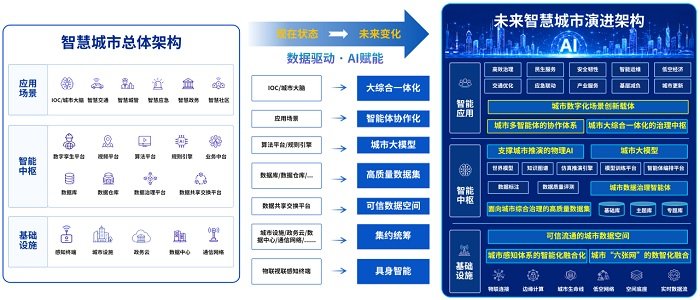
In recent years, driven by the development of "data elements X" and "artificial intelligence+", smart cities are moving from system construction and platform integration as the main focus to a data-driven and AI empowered overall evolution stage. Urban infrastructure is becoming more intensive and intelligent, data resources are upgrading from aggregation and sharing to trustworthy circulation and high-quality supply, intelligent centers are shifting from rule driven to model driven, and application scenarios are evolving from decentralized construction to comprehensive collaborative development. In the future, smart cities will gradually form a new development pattern of coordinated infrastructure, efficient circulation of data elements, unified empowerment of intelligent centers, and integrated operation of urban businesses.
Recently, at the 2026 China Internet Conference Digital Twin and Future Smart City Forum, Zhang Zhen, Deputy Director of the Institute of Industry and Planning of the China Academy of Information and Communications (hereinafter referred to as "the Chinese Academy of Information and Communications"), officially released and interpreted the "Ten Key Words of the 2026 Future Smart City", making a systematic study and judgment on the development direction and evolution trend of the smart city around the infrastructure, smart hub and application scenarios of the future smart city. The top ten keywords are the intelligent integration of urban perception system, the digital integration of urban "six networks", the trustworthy circulation of urban data space, high-quality datasets for urban comprehensive governance, intelligent agents for urban data governance, urban big models, physical AI supporting urban inference, governance center for urban comprehensive integration, collaborative system of urban multi-agent, and innovative carrier of urban digital scene.
1、 Intelligent integration of urban perception system: promoting the collective awakening of urban perception "nerve endings"
The intelligent integration of urban perception system is the integration of a large number of perception nodes such as cameras, sensors, satellite remote sensing terminals, etc. in the city into a unified neural network, promoting the city to be "visible, understandable, able to think, and able to make decisions". With the continuous enhancement of edge AI and sensing computing integration capabilities, perception terminals will gradually transform from data collection devices to intelligent nodes with analysis and decision-making capabilities. Multi domain perception data will be deeply integrated with urban spatial bases and digital twin systems, and further form a new urban perception ecology that involves the collaborative participation of multiple entities such as government, enterprises, and society.
2、 The integration of digitalization and intelligence in the "six networks" of cities: building a modern infrastructure for "multi network integration" oriented towards cities
The digital integration of the "six networks" in cities is to promote the transformation of water networks, new power grids, computing power grids, new generation communication networks, urban underground pipeline networks, and logistics networks from domain planning, independent construction, and decentralized management to coordinated layout, resource sharing, intelligent scheduling, and collaborative operation. In the future, we will further deepen the integration of urban computing networks and the coordination of computing and electronics, strengthen the spatial coordination and intensive construction of underground and above ground infrastructure, and rely on the digital twin base to gather various infrastructure operation data, promoting the integration of "six networks" from single network digitization to cross network digitization and intelligence.
3、 Trustworthy urban data space: solving the problem of "cross subject" data circulation and value release
A trustworthy urban data space is a new type of data infrastructure that connects multiple entities such as government, enterprises, and individuals in diverse scenarios such as urban governance, public services, and industrial development, supporting secure and controllable data circulation, compliant and efficient utilization, and collaborative value creation. Compared to traditional data sharing and exchange platforms, it places more emphasis on trusted identity, authorization management, privacy protection, process tracking, responsibility definition, and value allocation, promoting the transformation of urban data from internal departmental sharing to cross subject trusted circulation, and providing a more secure, transparent, and efficient environment for the integrated development and utilization of public data, enterprise data, and personal data.
4、 High quality dataset for comprehensive urban governance: enabling big models to truly 'understand cities and govern'
A high-quality dataset for comprehensive urban governance is a collection of data resources formed by collecting, managing, annotating, and evaluating policy knowledge, governance rules, disposal processes, real events, and other data around the business needs of urban governance. It is an important foundation for urban big models and governance intelligence to understand cities, carry out reasoning, and make decisions. In the future, the construction of urban data resources will shift from "storing data" to "training models", upgrading from a city data resource library to a governance knowledge base that accumulates urban governance knowledge and practical experience, and continuously optimizing data quality through model application feedback, forming a data flywheel where data, models, and scenarios promote each other.
5、 Urban data governance intelligent agent: from "human governance" to "intelligent governance", enabling urban data to "self heal, self optimize, and self prove"
Urban data governance intelligent agent is an autonomous intelligent governance system with AI big models as the core engine, aimed at the full lifecycle of multi-source heterogeneous data aggregation and access, standard formulation, quality control, security compliance, and circulation utilization in cities. It has the ability of "autonomous perception, intelligent decision-making, automatic execution, and continuous learning". In the future, urban data governance intelligent agents will move from auxiliary tools to a closed-loop autonomous governance system, evolving from a unified platform at the city level to a cluster of intelligent agents in segmented fields, forming a distributed autonomous governance system of "one brain, multiple bodies", achieving the autonomy, domain segmentation, and value operation of urban data governance.
6、 Urban Big Model: From "System Driven" to "Model Driven" Business, Building a City Level "Cognitive Decision Center"
The urban big model is based on a universal big model, supported by multi-source urban data and professional domain knowledge, and oriented towards the full scenario of planning and governance, public services, and industrial development. It has become a city level intelligent pivot engine with the ability of "self perception, self decision-making, adaptation, and self-learning". In the future, urban big models will evolve from text processing to multimodal fusion of text, image, spatiotemporal, and IoT, further enhancing the comprehensive understanding of the complex operational status of cities; Upgrading from a single intelligent tool to multi domain intelligent agent collaboration, supporting collaborative handling of complex tasks; And deeply integrate with digital twin cities, strengthen urban simulation and inference, trend prediction, and decision-making optimization capabilities.
7、 Physical AI supporting urban inference: driving future smart cities from 'digital inference' to 'physical execution'
The physical AI that supports urban inference is the integration and application of technologies such as digital twins, world models, spatial intelligence, and embodied intelligence in urban physical spaces, enabling AI to have environmental perception, task understanding, simulation inference, and execution feedback capabilities, supporting intelligent operation in urban governance, transportation, equipment maintenance, and other scenarios. In the future, physical AI will drive digital twin cities to extend from state mapping and virtual simulation to learning real laws and controlling real devices, gradually forming a closed loop of virtual environment training, intelligent model decision-making, embodied terminal execution, and result feedback optimization, and promoting the evolution of urban governance from online judgment to on-site execution.
8、 The governance center of urban comprehensive integration: the "digital operating system" that supports the digital transformation of the entire city
The governance center of urban comprehensive integration is the "smart brain" that drives the efficient operation of cities. By coordinating urban data resources, platform systems, algorithm models, and common capabilities, relying on the urban big model, it supports cross level, cross departmental, cross system, and cross business collaborative operation, and promotes the transformation of urban governance from traditional passive response to proactive foresight and scientific decision-making. The urban intelligence center is undergoing optimization and upgrading towards "facility interconnection, data integration, platform connectivity, and business connectivity", and is widely deploying AI intelligent agents. In the future, the urban governance center will evolve towards urban intelligent agents, promoting the leap of urban governance from "digitalization" to "integration" and "intelligence".
9、 Collaborative system of urban multi-agent: shaping urban dynamics and intelligent life forms
The collaborative system of urban multi-agent systems is based on urban big models and digital twins, deploying specialized urban AI agents with independent perception, reasoning, decision-making, execution, and learning capabilities in fields such as transportation, emergency management, and urban management. Through standardized communication, autonomous negotiation, and global game optimization among multi-agent systems, complex urban tasks are jointly completed. In the future, urban agents will evolve from a single model and centralized control of a single agent to a distributed collaboration of multi domain agents, promoting complex events from manual coordination and step-by-step flow to autonomous linkage, closed-loop disposal and continuous learning among agents.
10、 Innovation carrier for urban digital scenes: reshaping the urban competition logic of "giving money and land is not as good as giving scenes"
The innovation carrier of urban digital scenarios is a specialized operational organization and platform that integrates government data, public infrastructure, technological capabilities, and enterprise resources with real urban application scenarios as core resources, establishes precise supply-demand docking, technological verification iteration, and industrial ecological co construction. At present, typical carriers such as scene innovation centers, scene verification laboratories, scene open platforms, and scene operation companies are mainly formed. In the future, various carriers will accelerate their integration, gradually forming a "scene innovation complex" that integrates scene collection, open release, testing and verification, investment incubation, and promotion replication, and evolving towards a market-oriented operation and multi-party co construction scene innovation community.
Next, the China Academy of Information and Communications Technology will continue to track the technological evolution and industrial development trends of future smart cities, deepen research on key technologies, overall architecture, application models, and construction paths of future smart cities, actively promote industrial research, standard development, scenario cultivation, and ecological construction, and explore new development paths for future smart cities with all sectors, promoting the formation of urban intelligent life forms that are perceptible, thoughtful, collaborative, executable, and self evolving.